
The situation
The team expects staff to catch unsuitable drafts, but that safeguard has not been tested.
Lesson 8 of 12 · 5-minute lesson
Practise a difficult situation and preserve observations, actions and follow-up.
For: AI use case teams, incident owners and accountable leaders
This lesson uses National AI Centre guidance: Test your scenario, Test your scenario facilitator guide.
The situation
The team expects staff to catch unsuitable drafts, but that safeguard has not been tested.
The problem
A written process does not show whether people notice a failure, know who can pause work or recover safely.
The choice
The team runs a facilitated scenario using a realistic change in the assistant's behaviour.
What you will learn
The pivotal moments
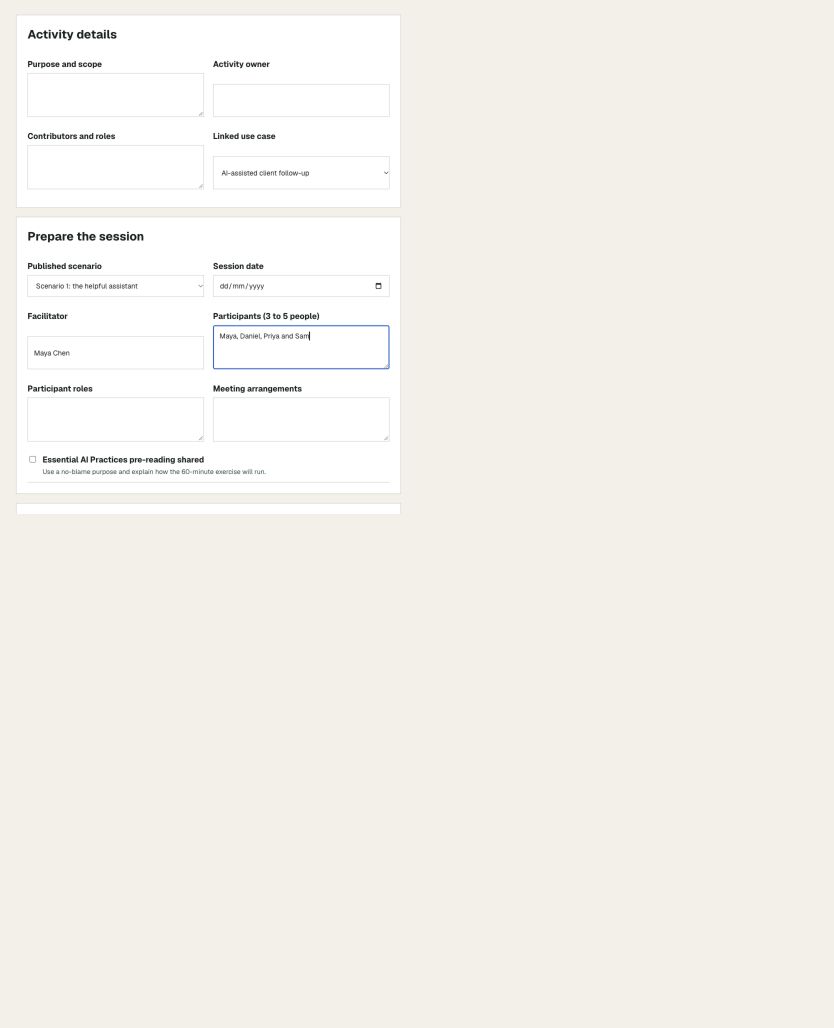
Moment 1
What the person does
Daniel names the participants, facilitator, purpose and limits.
What the workspace records
The session record defines what the exercise will and will not test.
Notice
A clearly limited scenario produces more useful observations.
Why it matters
The team tests a defined situation rather than discussing AI in general.
Moment 2
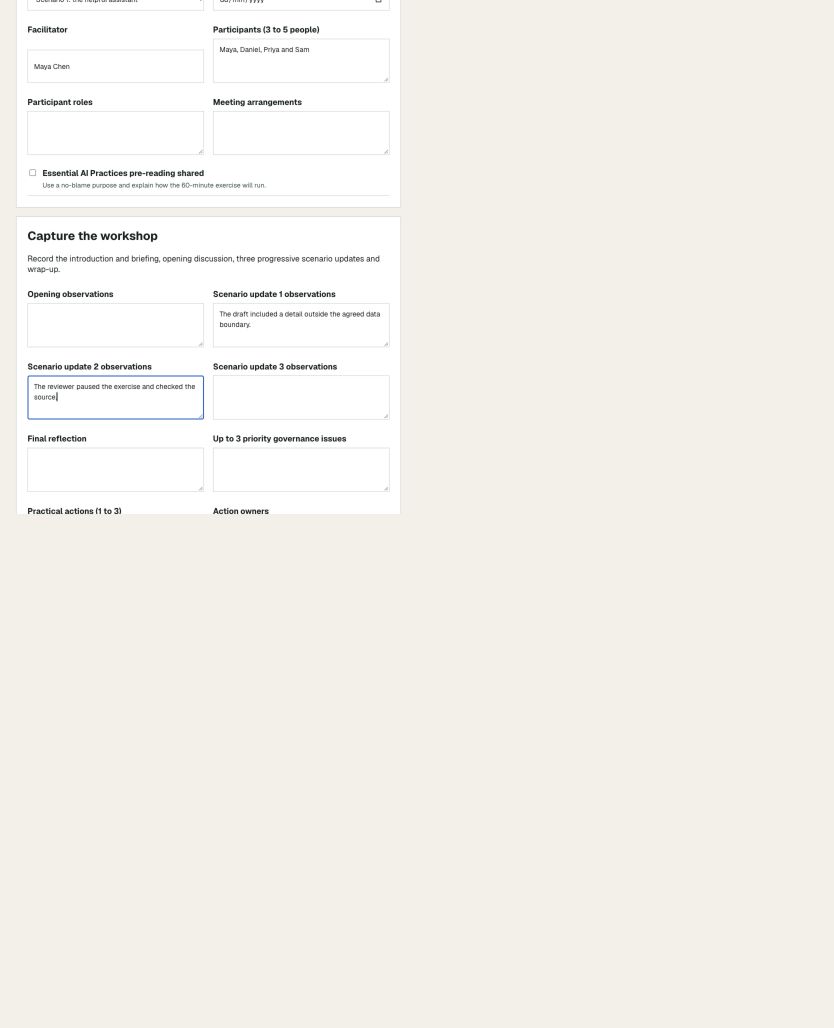
What the person does
The facilitator reveals an inaccurate client draft.
What the workspace records
Participant observations and actions are recorded as the situation changes.
Notice
People disagree about who can pause the test.
Why it matters
The exercise reveals how control performs under pressure.
Moment 3
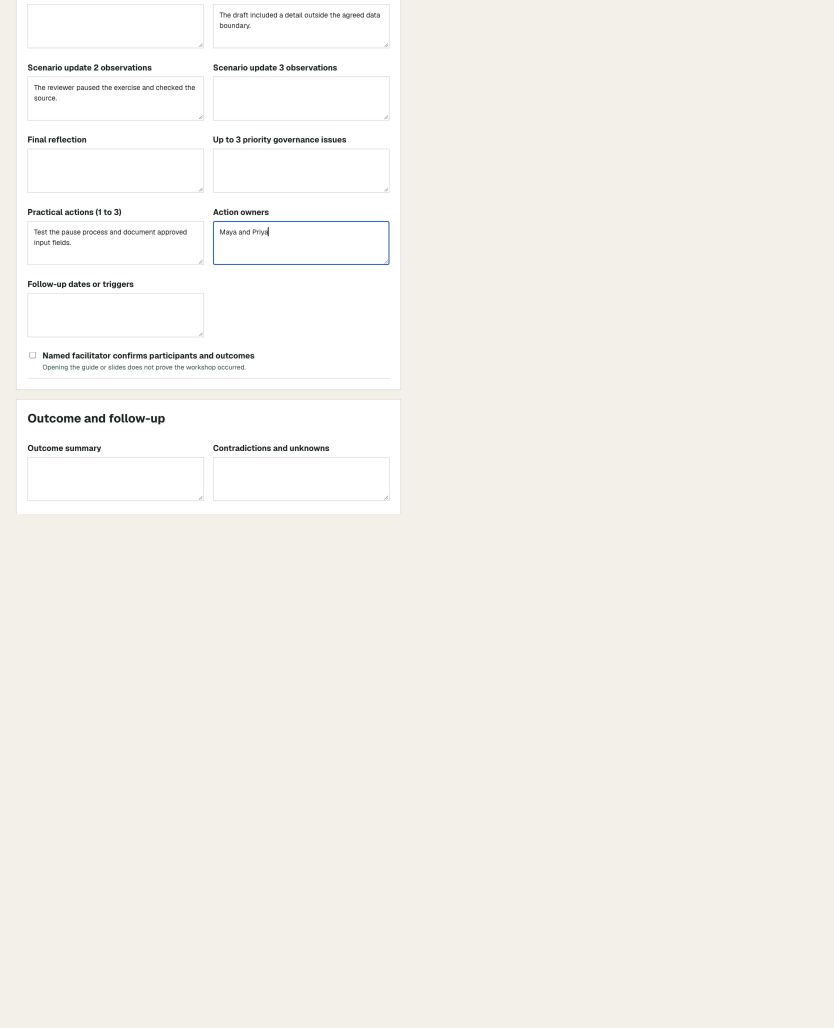
What the person does
Daniel records issues, owners, evidence needs and a follow-up trigger.
What the workspace records
The result remains connected to the use case.
Notice
Discussion notes alone do not show that an issue is resolved.
Why it matters
The exercise strengthens preparation and assessment evidence.
Official guidance used in this lesson
National AI Centre
Explains the team scenario activity and links its resources.
Last checked 30 September 2026
National AI Centre
Provides the published facilitator guidance.
Last checked 30 September 2026
The complication
Participants disagree about who owns the pause decision and how affected clients would be told.
The outcome
The exercise produces owned actions, evidence needs and a clear follow-up trigger.
Check your understanding
Its observations become connected actions, evidence needs, owners and follow-up timing rather than remaining in discussion notes.
Key points
What happens next