
The situation
A limited test is proposed, but the decision is not yet approved and several conditions remain open.
Lesson 11 of 12 · 6-minute lesson
Manage conditions until evidence is reviewed and respond when circumstances change.
For: Accountable executives, action owners and reviewers
This lesson uses National AI Centre guidance: Guidance for AI adoption: foundations, Guidance for AI adoption: implementation guidance.
The situation
A limited test is proposed, but the decision is not yet approved and several conditions remain open.
The problem
A decision report creates false confidence if its conditions disappear into meeting notes or email.
The choice
Maya assigns each action, states the required evidence and sets the next review trigger.
What you will learn
The pivotal moments
Moment 1
What the person does
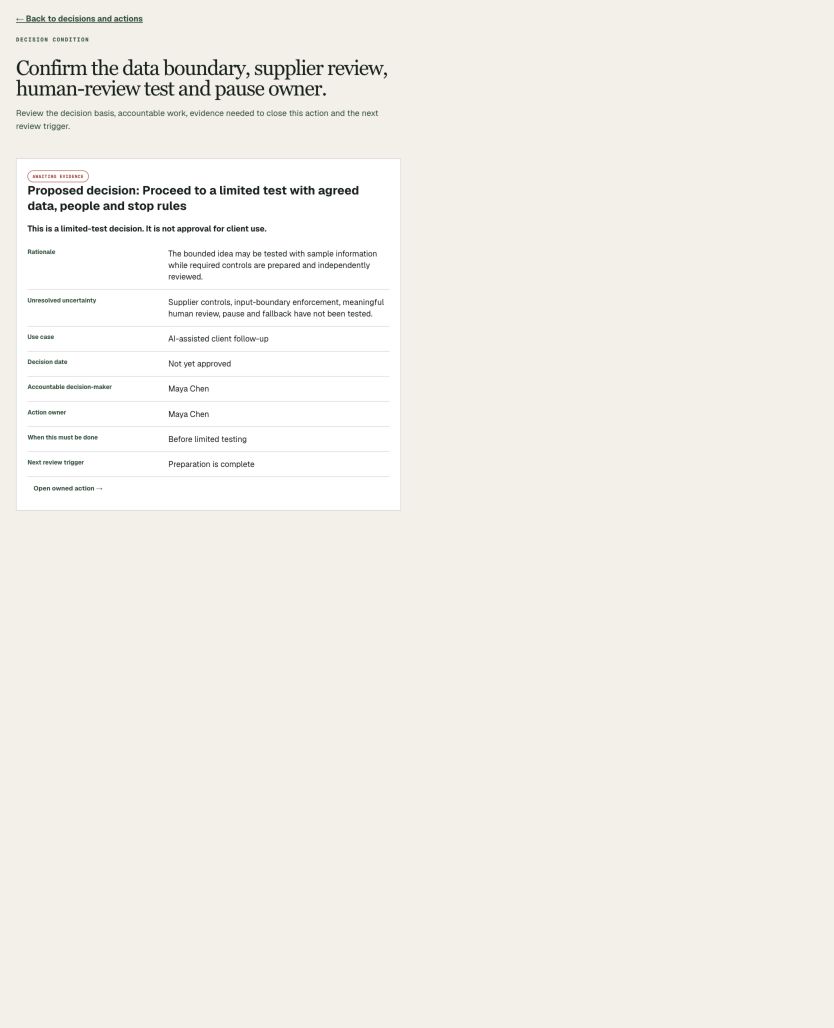
Maya records the proposed limited test separately from live use.
What the workspace records
The proposal keeps the reasons, uncertainty and conditions.
Notice
An unapproved proposal cannot be treated as permission to test.
Why it matters
Everyone can see what is proposed and what remains unapproved.
Moment 2
What the person does
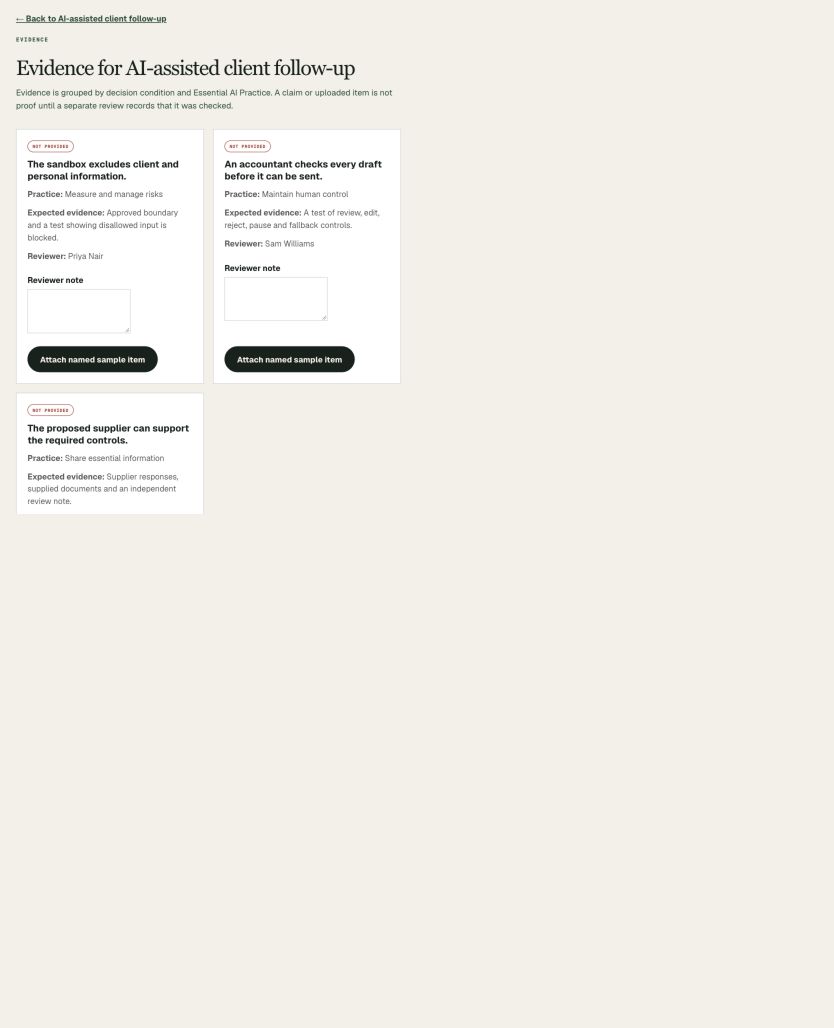
Each owner sees the action and what a reviewer must see.
What the workspace records
The action links to its condition and required evidence.
Notice
Marking a task done does not prove that a control works.
Why it matters
Owners know what is needed before an action can close.
Moment 3
What the person does
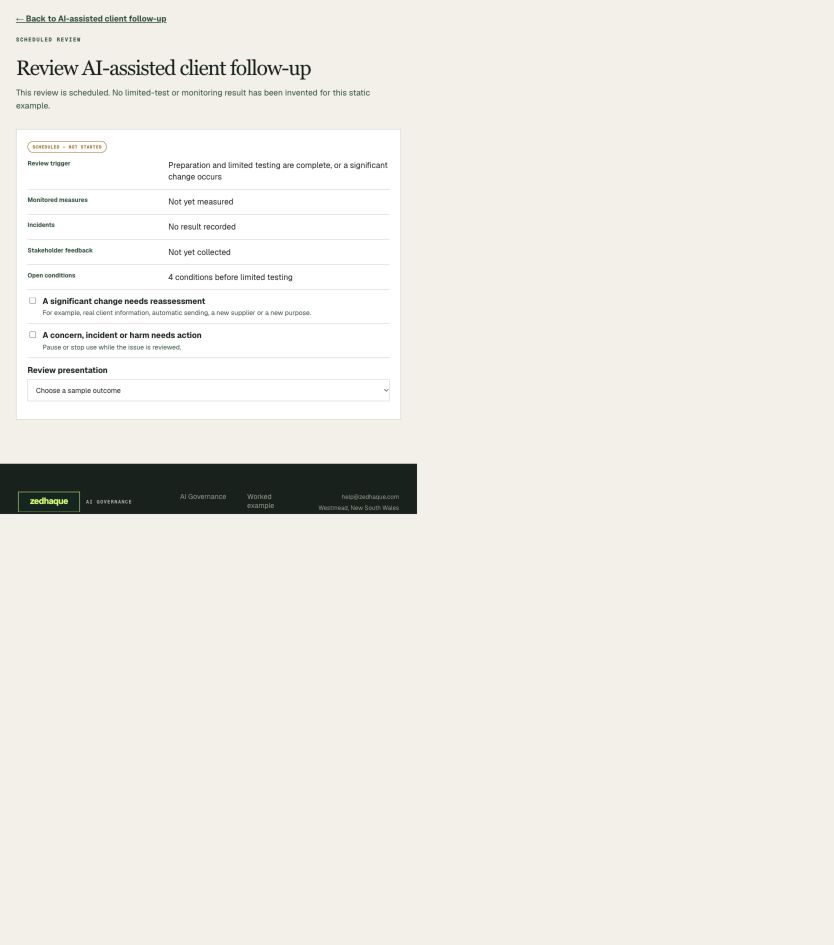
Maya schedules a review and records other triggers.
What the workspace records
An incident, new purpose, different supplier or new type of data can reopen the review.
Notice
A file alone cannot close a condition.
Why it matters
Governance stays active as the proposal moves through approval and testing.
Official guidance used in this lesson
National AI Centre
Provides core actions for organisations beginning responsible AI governance.
Last checked 30 September 2026
National AI Centre
Provides operational detail for more established governance work.
Last checked 30 September 2026
The complication
Completing an action and demonstrating that its control works are different claims.
The outcome
The proposed decision, conditions, actions, evidence and review stay connected to the use case while approval remains outstanding.
Check your understanding
After the required evidence is submitted and an authorised reviewer accepts it—not when a task is merely marked complete.
Key points
What happens next