
Lesson 7 of 19
Create and apply an AI policy
Prepare and review an organisation AI policy. Check its actual saved state and version before selecting it for a task.
This lesson concerns artificial intelligence (AI) governance: how your organisation assigns responsibility, checks AI use and records decisions and follow-up. AI Governance keeps these records; it does not operate the external AI tool for you.
At the end of this lesson
- Choose template or existing-policy import appropriately.
- Distinguish draft, adopted version and reference guidance.
- Check the intended policy link and limitations.
Before you begin
This lesson is for policy owners and authorised administrators/approvers. You can read and complete the paper activity without an account.
For optional workplace practice, have the organisation context and current policy-editing permission. Adoption needs the appropriate administrator and organisational authority. Reading this lesson requires no actual adoption. If access is blocked, record your proposed response in your notes and ask the responsible administrator to check access.
Key ideas
Organisation policy is distinct from external guidance. Adoption records a decision and version; it does not demonstrate that staff comply or that controls work.
Follow these steps
1. Check existing policies
Open Policies and inspect the organisation’s existing records and versions. Keep organisation policy separate from external reference guidance.
Check the result: You know whether an existing version meets the task before starting another.
2. Choose a starting point
Select Use the policy template for guided drafting or Import existing policy for an existing document. Neither choice adopts policy automatically.
Check the result: You have the appropriate editable starting point.
3. Review the draft
For an import, examine recognised sections, missing information and Review unmapped content. For either route, review each relevant section and correct unsupported statements.
Check the result: The draft reflects the organisation’s actual position and preserves unresolved questions.
4. Retain the right state
Identify the policy owner and the organisation’s approval process. Save the draft while review remains incomplete. An imported approval claim is not a new adoption action.
Check the result: The saved draft can be reviewed without pretending adoption occurred.
5. Record authorised adoption
An authorised administrator reviews the intended version and supplies the approver and effective information required by the adoption form. Use the supported adoption action only with authority.
Check the result: The saved policy displays its actual state and version. An error or pending operation is not adoption.
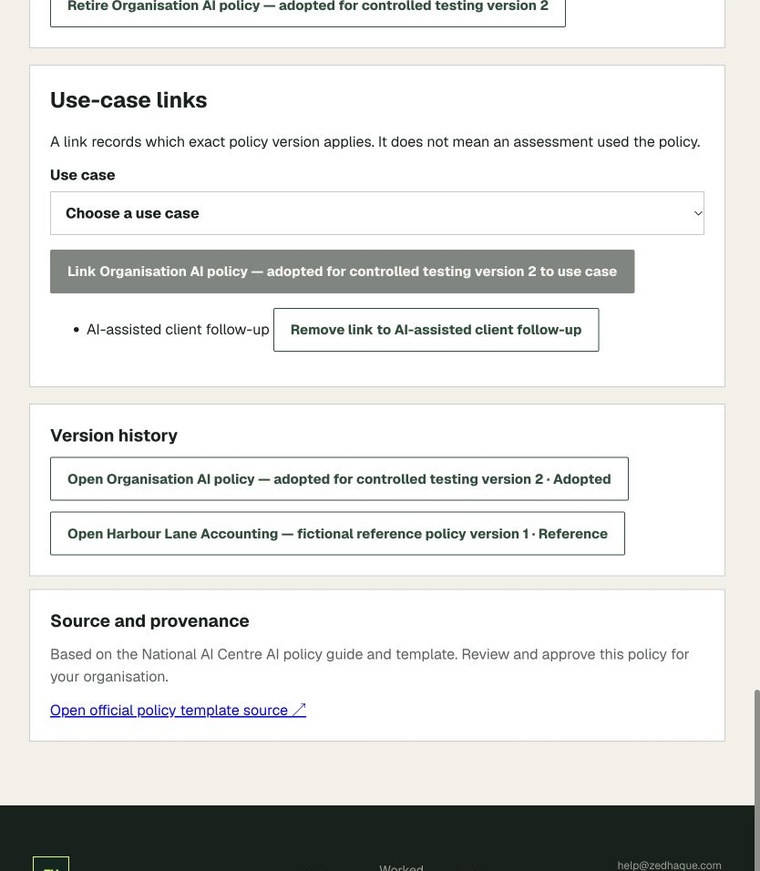
6. Select the intended version
Check the policy chosen for the use case or assessment. Preserve earlier saved selections when a later policy version appears. Explain any missing-policy limitation.
Check the result: The chosen version is deliberate. Adoption still does not demonstrate that people follow it or that controls work.
Practise
Paper activity — fictional information
'Your organisation has an approved policy document. The import recognises most sections but leaves a section unmapped.' Write the next action and the state to retain while checking it.
Write your response in your own notes before opening the answer. You do not need to sign in, change records or run an assessment.
Check your understanding
Does importing the document make it the adopted policy for every assessment?
Check your answer
No. Review the imported content, use the authorised adoption process and deliberately select the intended version. Keep it as a draft if approval is pending. Reread steps 3–6 if import is treated as adoption.
For the activity, inspect and reconcile the unmapped section against the approved document. Retain a draft until the appropriate review and adoption have been authorised. Import alone does not select the policy for every assessment.
Check your work
- Starting method is appropriate.
- Policy state/version is accurately identified.
- Linkage does not imply control effectiveness.
Continue learning
Optional worked examples
Sources
These National AI Centre resources inform the lesson. This course does not imply Australian Government endorsement.