
The situation
Client follow-up work is slow and inconsistent, and the team wants to know whether AI could help.
Lesson 6 of 12 · 5-minute lesson
Map current work before deciding whether AI is an appropriate response.
For: Business sponsors, process owners and affected teams
This lesson uses National AI Centre guidance: Identify opportunities, Business process mapping template.
The situation
Client follow-up work is slow and inconsistent, and the team wants to know whether AI could help.
The problem
Starting with a product can hide the real process problem and move effort to the wrong place.
The choice
Daniel maps the current steps, hand-offs, pain points and candidate opportunities.
What you will learn
The pivotal moments
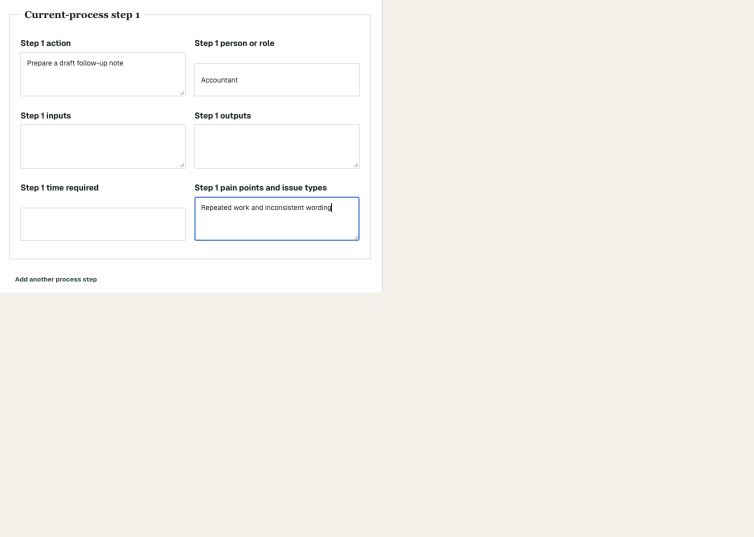
Moment 1
What the person does
Daniel records ordered steps, owners and hand-offs.
What the workspace records
The workspace preserves the current process before redesign.
Notice
The process contains several human decisions.
Why it matters
The team sees the work rather than an assumed solution.
Moment 2
What the person does
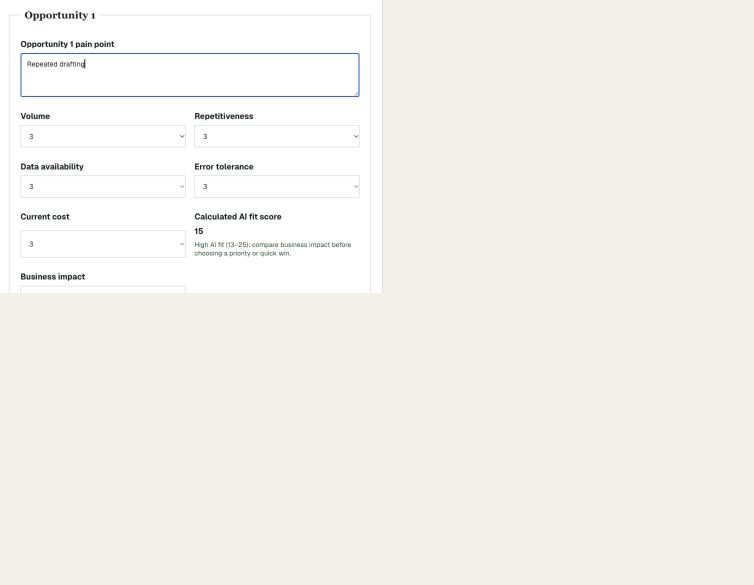
Daniel records delays and rework separately from proposed changes.
What the workspace records
Pain-point rows and opportunity rows stay distinct.
Notice
A painful step is not automatically suitable for AI.
Why it matters
Benefits can be tested against a real problem.
Moment 3
What the person does
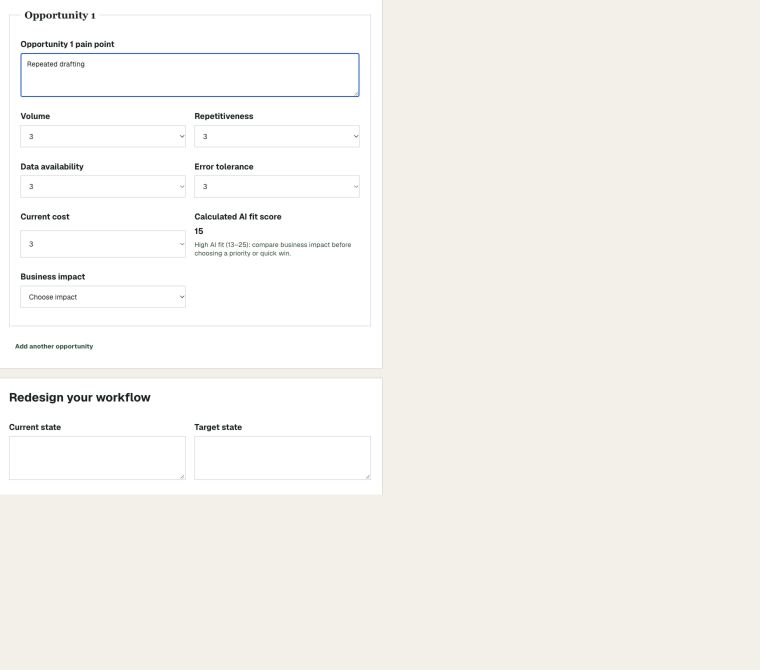
The team reviews five factors and the calculated range.
What the workspace records
The result explains the 5–12 and 13–25 planning ranges.
Notice
The range is planning guidance, not approval or a suitability result.
Why it matters
A clearly limited drafting opportunity can move to governance checks.
Official guidance used in this lesson
National AI Centre
Explains process mapping and opportunity identification.
Last checked 30 September 2026
National AI Centre
Provides the published mapping template.
Last checked 30 September 2026
The complication
The highest-friction step may still be unsuitable if the information, impact or human-control needs cannot be managed.
The outcome
The team identifies a clearly limited drafting opportunity and records why it merits further investigation.
Check your understanding
No. It helps the team interpret the opportunity. Screening, preparation, assessment and an accountable decision still follow.
Key points
What happens next